In the last installment we looked at the abstract geometry of the tobacco chamber in order to gain some understanding of how bowl diameter, height, and shape impact on the performance of the pipe. We now turn to to other hole in the pipe, the airway. In my opinion, the airway is the most important design factor impacting on overall pipe performance.
The two characteristics that are bandied about when the topic of the airway comes up. Airway diameter, and turbulence caused by transitions in the airway. We will look at each of these variables in turn and try to understand the impact they have on the smoking experience.
Airway Diameter
In my experience, airway diameter in the stummel shank can vary from 1/8 inch (3.2 mm) up to 3/16 inch (4.8 mm). The airway through the stem will typically start at a similar diameter and taper down to about 1/16 inch. But it is a bit more complex as the button end of the airway is typically funneled. For the sake of understanding the impact of airway diameter on pipe performance, we once again will start with a simplified system and add in some complications later. To start, we will model the full airway (stem + shank) as a simple tube, or straw.
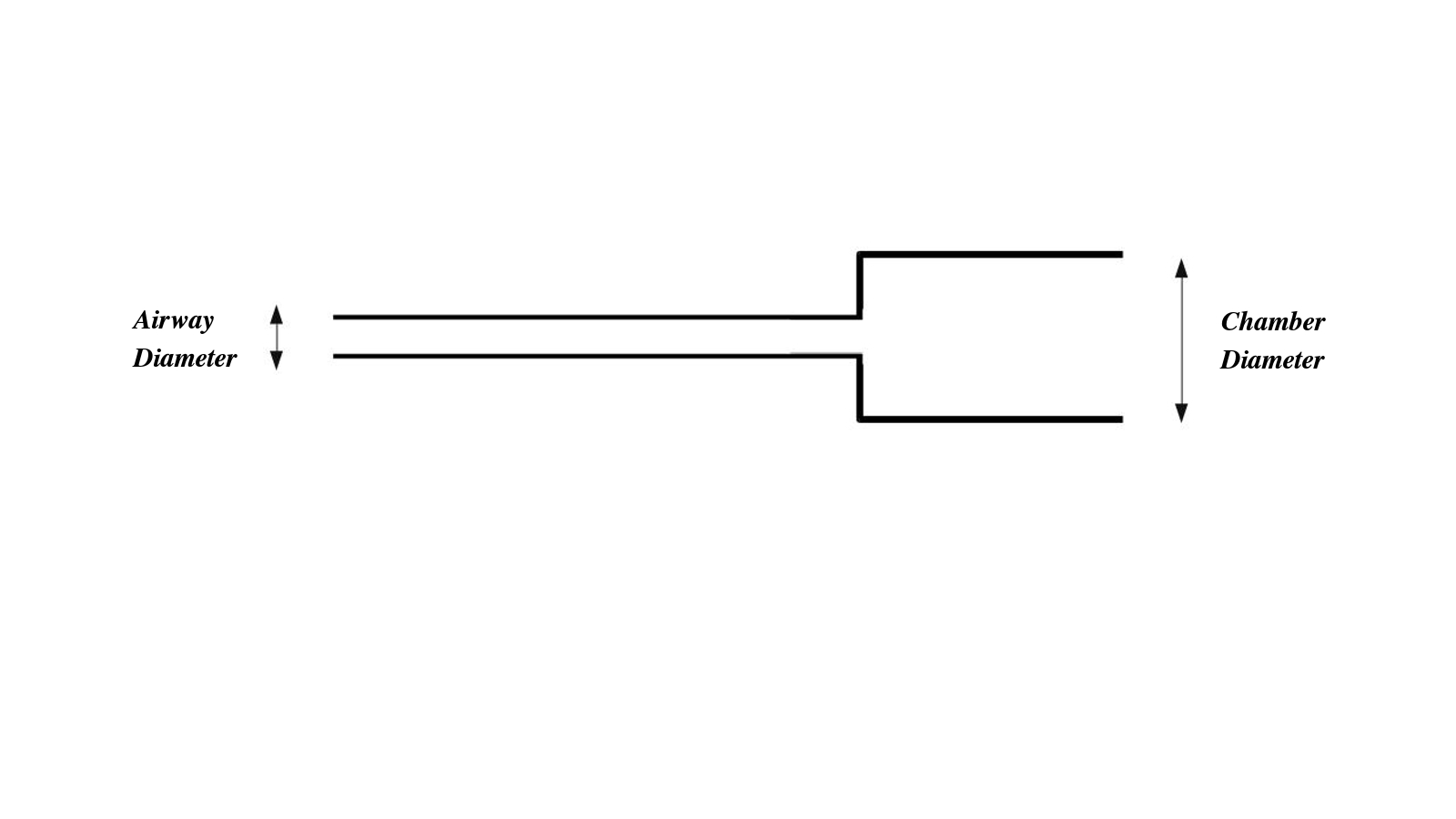
By modeling the airway and chamber in this way, we can treat it as a laminar flow in a step down in a pipe and use Bernoulli’s principal to model the velocity of the air as it moves through the system. Don’t worry, the math is not important to understand. All you need to know is that as air moves from a large diameter pipe to a smaller diameter pipe, the velocity of the air increases. I used an online calculator and made some simplifying assumptions to get the ratio of velocity between the tobacco chamber and the airway.

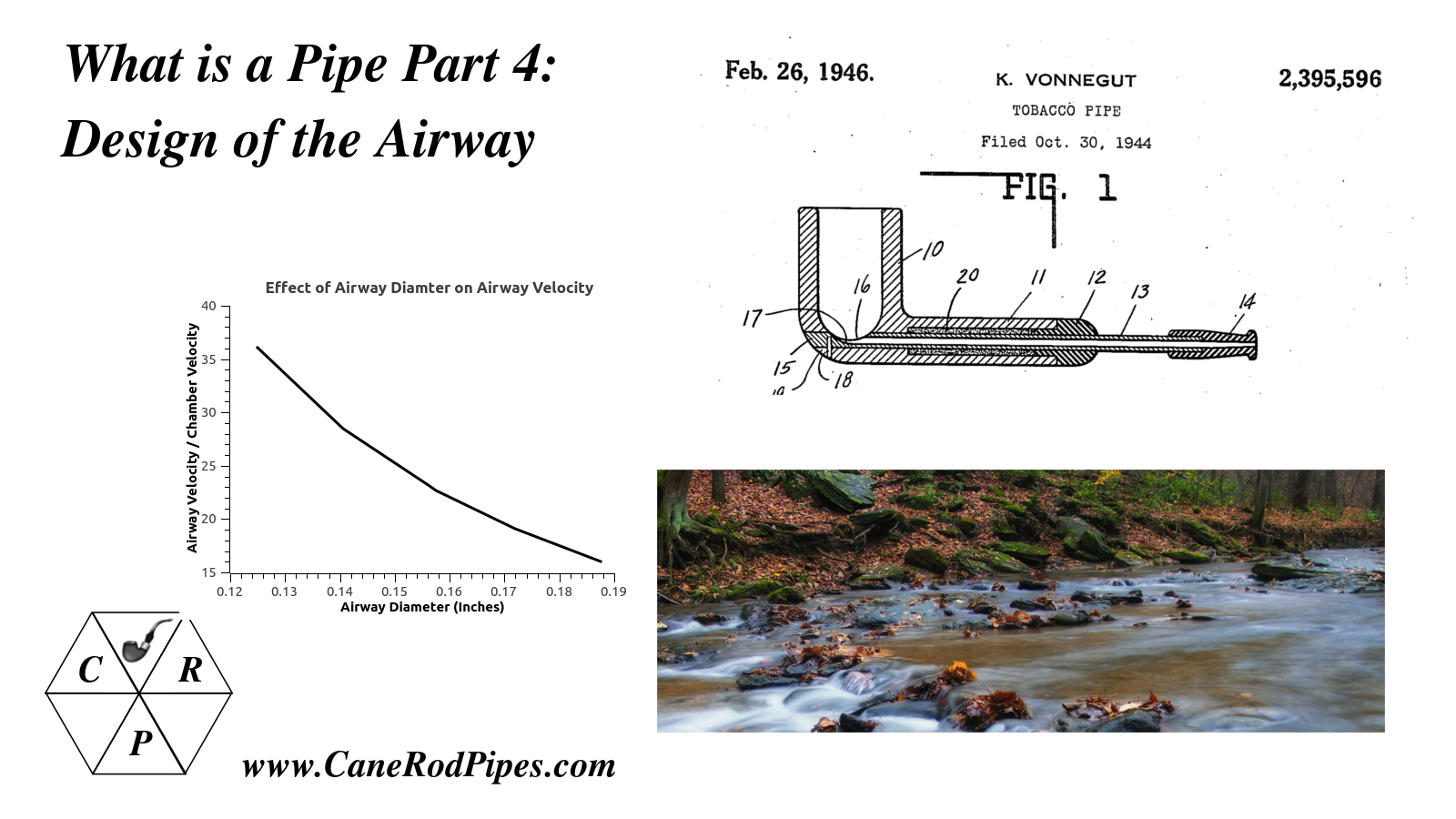
We are assuming a ¾ inch diameter tobacco chamber, and keeping the temperature at 20 degrees C. We are also assuming laminar flow throughout the system. The last two variables are obviously not correct, but it does not matter as are all held constant and we only vary the diameter of the airway to determine how the velocity of the air changes between the tobacco chamber and the airway as a ratio (in other words, the influence of our guesses cancels out). This produces the following relationship.
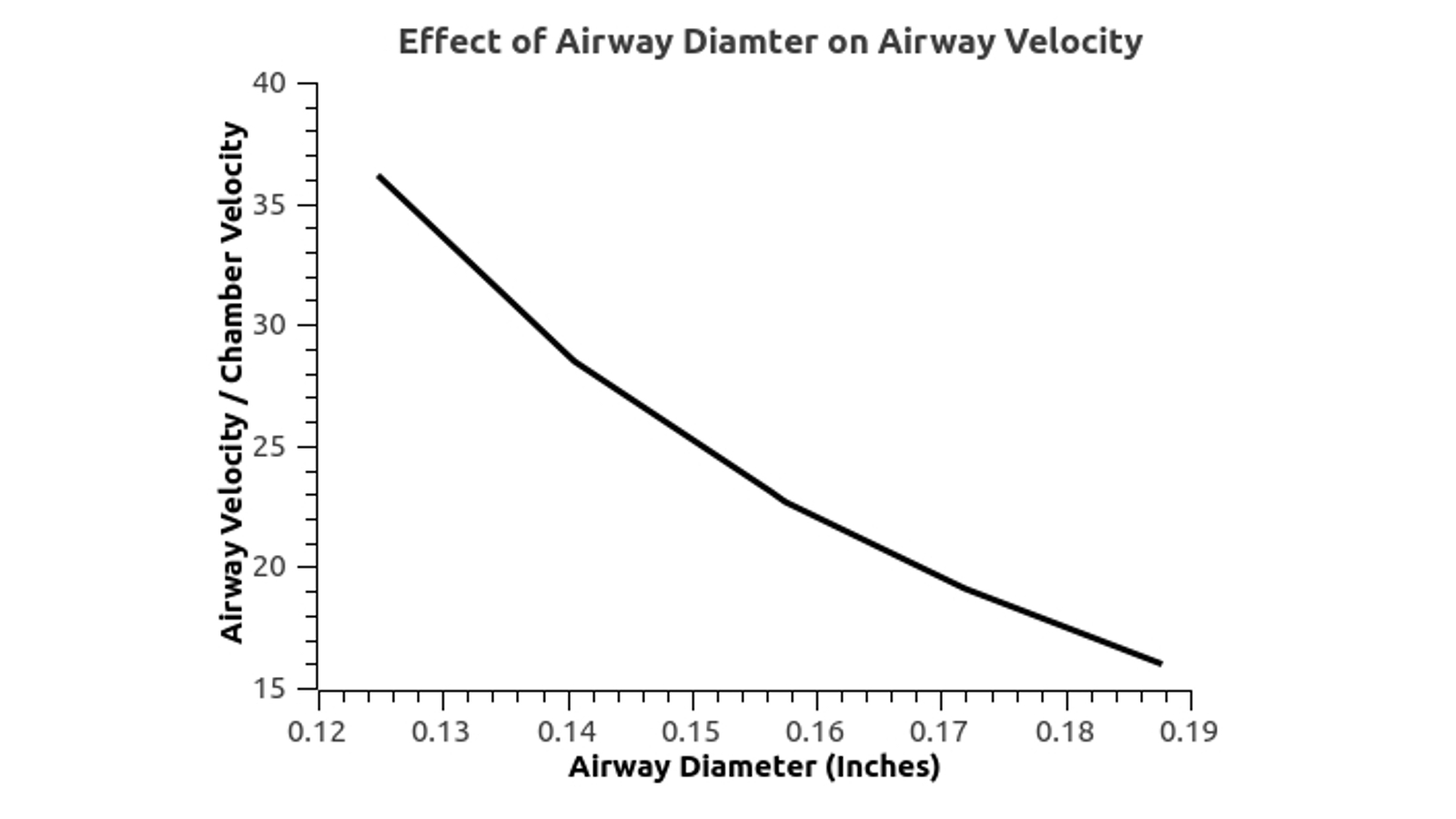
The graph shows how much faster the air is moving through the airway compared to how fast it is moving through the tobacco chamber. The x-axis represents airway diameters from 1/8 inch (0.125) up to 3/16 inch (0.1875). As you can see, at 1/8 inch, the air is moving more than 35 times faster in the airway than it does in the the tobacco chamber. This is important for two reasons. First, the smoke needs some time to cool before it enters the mouth. The faster it moves through the airway, the hotter it will be. So a narrow diameter airway will lead to a hotter smoke unless it is very carefully sipped. The second reason that this is important is that the faster the smoke moves, the more likely it is to become turbulent. Friction along the walls of the airway will lead to the production of swirling eddy currents which, as we will see below, will lead to moisture accumulation and gurgling.
Rick Newcombe, the author of the excellent “In Search of Pipe Dreams” has famously advocated for an airway diameter of 5/32 inch (0.156 inch or approximately 4 mm) for both the stem and shank. He claims that pipes drilled in this way smoke more easily, and stay lit longer. While many pipe makers agree on this point, the problem that is often pointed to is that such a large bore through the stem will weaken the ebonite to the point where most smokers will easily bite through the stem. Because of this, many pipe makers have developed the idea of a constant volume of air moving through the airway as being the key to a great smoking pipe. And in fact, this may be the key to why Newcombe’s method works so well.
Turbulence
The straight 5/32 inch airway through the stem and shank is very close to what we have modeled above. As you can see from the graph, 5/32nds (0.156) falls right in the middle. So air is still moving about 25 times faster through the stem than through the tobacco chamber. But it is moving through a straight tube with very little turbulence.
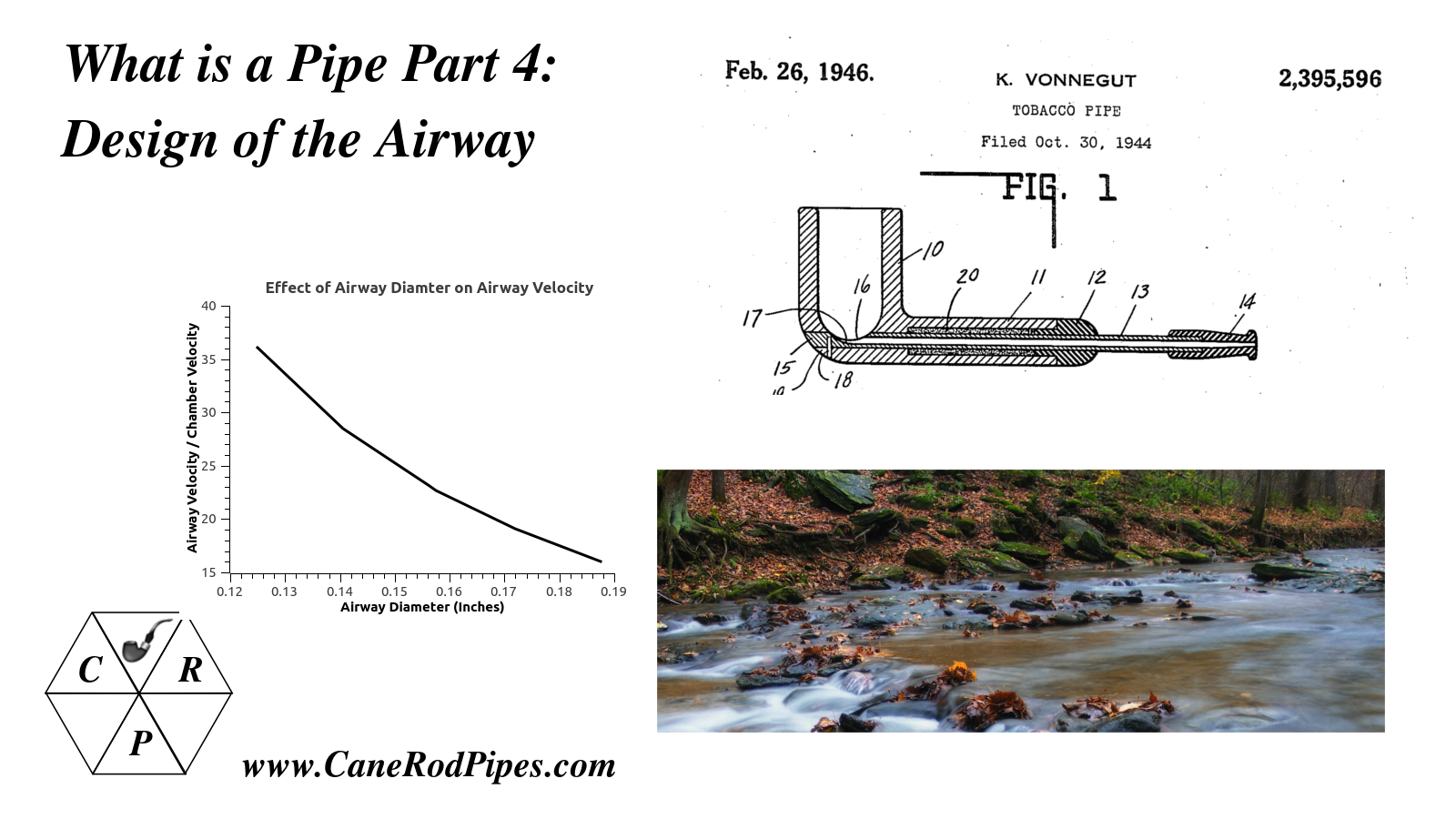
Turbulence occurs when the smooth laminar flow of air is disrupted and made chaotic from it’s interactions with the surrounding structure. If you have ever observed a flowing river or creek, you notice that there may be areas of smooth flow near the center of the stream, but swirling eddy currents are observed near the edge where the friction of the bank breaks up the flow. Eddies also occur around rocks or other obstructions in the stream, at sharp turns, or when the stream abruptly narrows or widens.

The occurrence of these circular eddy currents in a stream of smoke moving through a pipe has a significant negative consequence. Smoke is a suspension of soot, flavor components, and water. When the smoke moves through these vortexes, it undergoes cyclonic separation (just like those fancy vacuum cleaners) causing the heaviest components to precipitate and accumulate on the walls of the airway. This leads to a gurgling wet smoke that is clearly undesirable. So a straight 5/32 inch diameter airway works well because it both decrease the velocity of the smoke and eliminates turbulence.
To bring all this together, we will first look at an example of a poorly designed airway. Keep in mind that I am no draftsman, so the figures below are not to scale and made only for the sake of illustration.
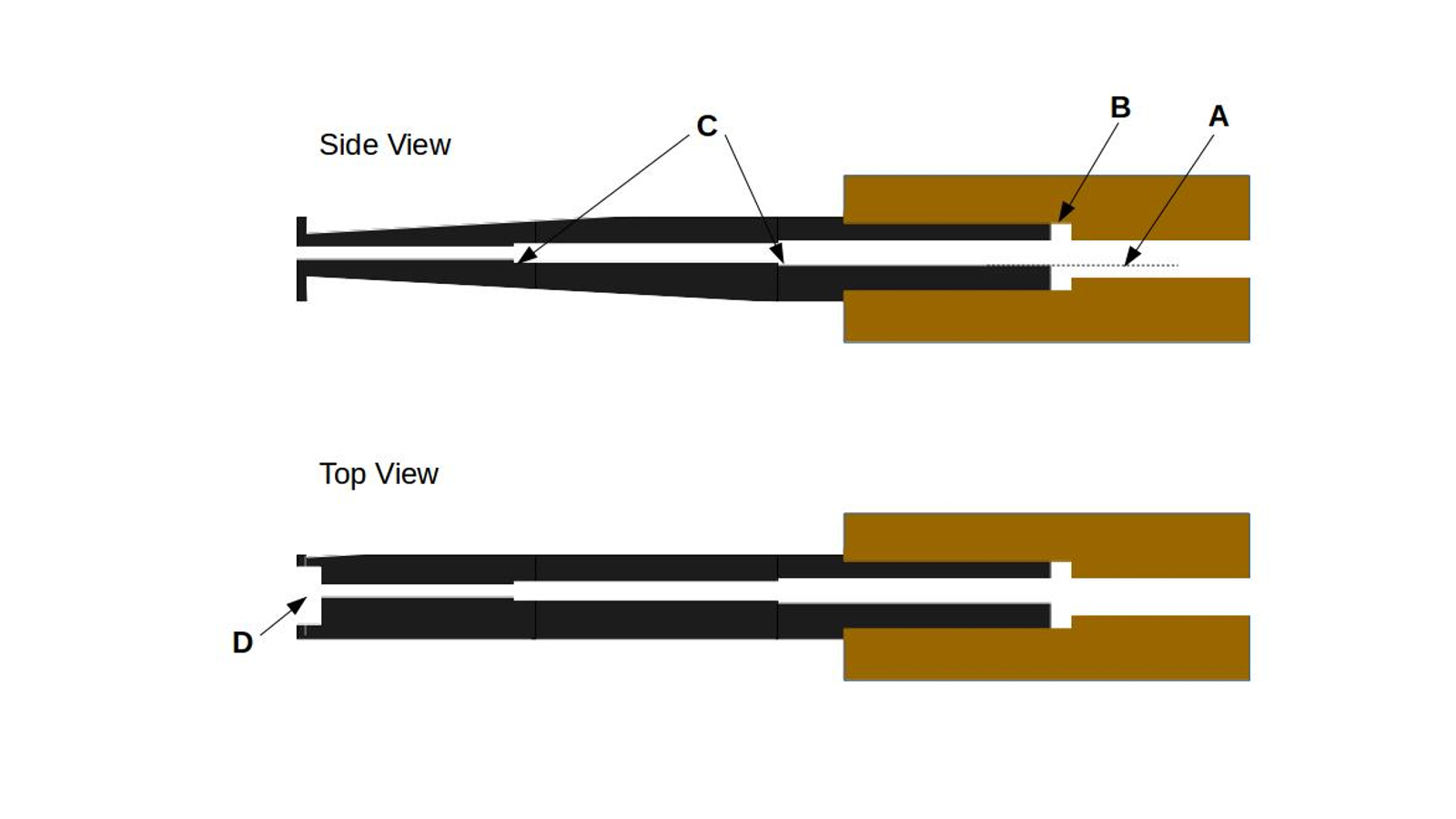
There are several problems with the design in the figure above. The key points are labeled with letters so we can refer to each in turn. First, notice that the drilling of the shank does not line up with the drilling of the stem (A). This is made worse by the fact that the stem airway diameter is smaller than the shank airway diameter. This will lead to turbulence at the junction of the stem and shank (caused by the ledge of the offset) and an increase in velocity as smoke moves into the narrower airway. To make matters worse, the end of the tenon is short of the bottom of the mortise (B) which will be an area of turbulence and a spot that will collect moisture. As discussed above, the diameter of the airway at the button needs to be smaller than that at the mortise in order for there to be enough material to withstand the smokers clenching bite. In this example, that is accomplished by stepping down the diameters (C) which will lead to additional turbulence. Finally, the slot at the button end as seen from the top (D) is a rectangular cutout which again will lead to turbulence and, combined with the narrow airway just before the slot, will result in hot wet smoke hitting the smokers tongue.
All of these issues can be alleviated with proper design. This is easiest to accomplish when making a stem from rod stock, but pre-molded stems also can be modified with careful filing and sanding to produce a good performing airway. A generic example of an ideal airway is illustrated below.
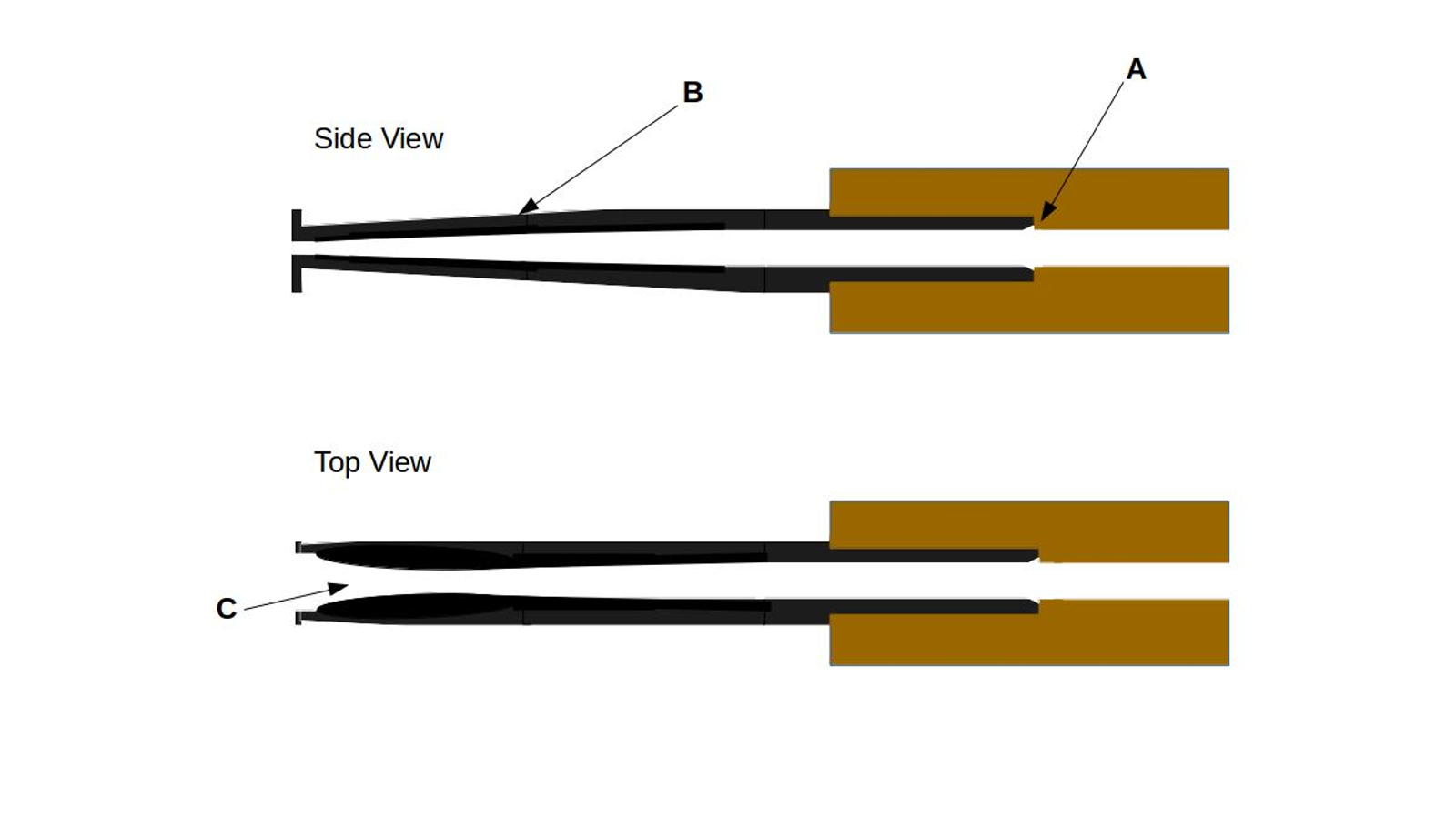
The first thing that will be noted about the well designed airway is that the end of the tenon meets the bottom of the mortise (A). There is also a slight chamfer added to the end of the airway at the tenon end that creates a slight ledge, but insures that even if there is an offset in the drilling (as seen in the poor design example above) it will provide a smooth transition between the shank and stem. Note that there are no sharp transitions. Where the airway must narrow as it approaches the button, there is a smooth taper (B) that allows for ample material to remain in the bite zone. While at first this might seem like it would lead to an acceleration of the smoke as it is drawn through the final inch or so of the airway, a look at the top view shows how that problem is avoided. By carefully funneling the slot (C) and providing a smooth transition between the funnel and the rest of the airway, the overall volume of the airway an be maintained despite the narrower (in one dimension) passage. This constant volume design provides the perfect balance to allow a smooth flow through the entire airway. The transition between the funnel and the rest of the airway is a critical point. If this is too abrupt, or pinches in like an hourglass, it will be a significant cause of turbulence. If you have ever had a stem whistle, this is the likely culprit.
So we now have a reasonable understanding of the holes through the pipe, and surprisingly we find that we can explain many, if not all, of the properties of a good or a bad smoking pipe based just on the design of the holes. In other words, the most important part of the pipe is what the carver removes from the inside. But of course, for the pipe to exist there must be some material boundaries around these spaces. Future installments will focus on the materials used to make the stummel and stem.
Hi Mike,
After reading your paper I was transported back to my senior college class in Hydrodynamics 375. Your explanations were much easier to comprehend and without the dreaded mathematics. Thanks for the blog and the memories of past good times. Your friend.
James
That very informative, good job CaneRod