

For 86 years the Zippo Manufacturing company of Bradford PA has been making the iconic Zippo lighter. The Zippo has an unmistakable appearance and feel in the hand, and an instantly recognizable sound. Sure the lighter has it’s critics, and there are certainly some negatives to using a Zippo for pipe smoking that I will get into below. But there is a primary reason the company has made over 500 million lighters and continues to survive in the present anti-smoking era – customer satisfaction.
The design of the Zippo is deceptively simple. A brass case containing an insert represents the working heart of the lighter. Mounted to the insert is a spring loaded cam which keeps the lid closed and provides that satisfying Zippo clink. The innards are quite simple with a friction fit wick, rayon wadding to hold the fuel, and a felt pad to hold everything together. There is also a tube with a screw-captured spring that hold the flint in place below the striker wheel. The striker is a simple knurled wheel mounted to the top next to the distinctive chimney which provides the lighter its windproof quality. A pipe style chimney is also available containing holes in the sides that allow the flame to be drawn down into the tobacco chamber. Surprisingly, this simple design requires 108 manufacturing steps to fabricate and assemble.

There are several reasons that Zippo lighters have such enduring popularity. One is simple reliability, the lighters work well and continue to work well with very little maintenance. Another reason is variety. The interchangeable case has been produced in a very large variety of designs as is evidenced by even a quick look inside the Zippo museum in Bradford PA.

If you have an interest, Zippo has probably made a case for it. Everything from military unit insignias to hippy peace signs. From Marylin Monroe to Marylin Manson. From the Beatles to VW Beetles. This has made the lighters highly collectible and items that can have a great deal of significance for the owner. They can even be personalized with custom engravings.

But the number one reason Zippo has endured is good old fashioned customer service. In 86 years no one has ever paid to have a Zippo lighter repaired. They will repair any Zippo lighter and return it to its owner in like-new condition for the cost of postage. You can find information about the repair service and instructions on preparing your lighter for shipping at the Zippo Website
As I mentioned above, there are some notable negatives to using Zippo as a pipe lighter. The most common objection is that the flame from a Zippo will char the rim of the pipe. Frankly any lighter will char the rim if it is not used with care. But the Zippo flame is less focused than some other style pipe lighters and therefore does require additional care. The second common complaint about Zippos is the claim that the fuel imparts a taste that is unpleasant enough to ruin a smoke. I do remember that the older formula Zippo fluid had noticeable taste, but it only was evident while lighting the pipe and did not effect the tobacco once lit. The modern version of fluid that Zippos sells has, in my opinon, no discernible taste. The final criticism that is often repeated regarding the Zippo lighter is that the fuel evaporates and the lighter requires frequent refills. This is, in fact, true. The case does not seal to the fuel chamber and the fuel will typically not last more than a few days even with infrequent use. The solution to this problem is to fill the lighter each day with enough fuel to last for the day. The amount may vary, but I find that one long (count 5) squeeze of the bottle is enough. In time, this becomes another of the rituals of pipe smoking.
The Zippo below has been my go to lighter since I purchased it 1990. I bought it at the first real tobacconist I regularly visited and it was suggested and sold to me by a wonderful elderly woman who had forgotten more about pipes and tobaccos than I will ever know. It has served me well and has traveled around the world with me. There was one “tragic” experience that caused me to put it in a drawer for a period of time. I was visiting Cambridge University and went for a walk one evening. The sun was just about setting as I stood on a bridge over the river Cam watching punters push their boats along the river. I packed a pipe and took out the lighter to strike and to my horror watched as the chimney detached and fell into the river below. I felt like I had lost an old friend. I eventually learned about Zippo’s warranty and shipped what was left of the lighter to them for repair. In a few weeks they had returned the lighter in perfect working condition and all I had to pay was the cost of shipping.

With customer service like that, it might seem odd to even bother with the process I am going to describe here. But the thought of spending a few weeks without my favorite lighter is hard to accept. Twice in the 28 years I have had this lighter, I have noticed that it became difficult to strike. My theory on why this happens is that the striking wheel becomes glazed and no longer creates a sufficient spark to light the fuel. The last time this happened I went through a relatively simple process to get it back in working order, so I will try that again and see if it works before packing up my friend for a trip to Bradford.
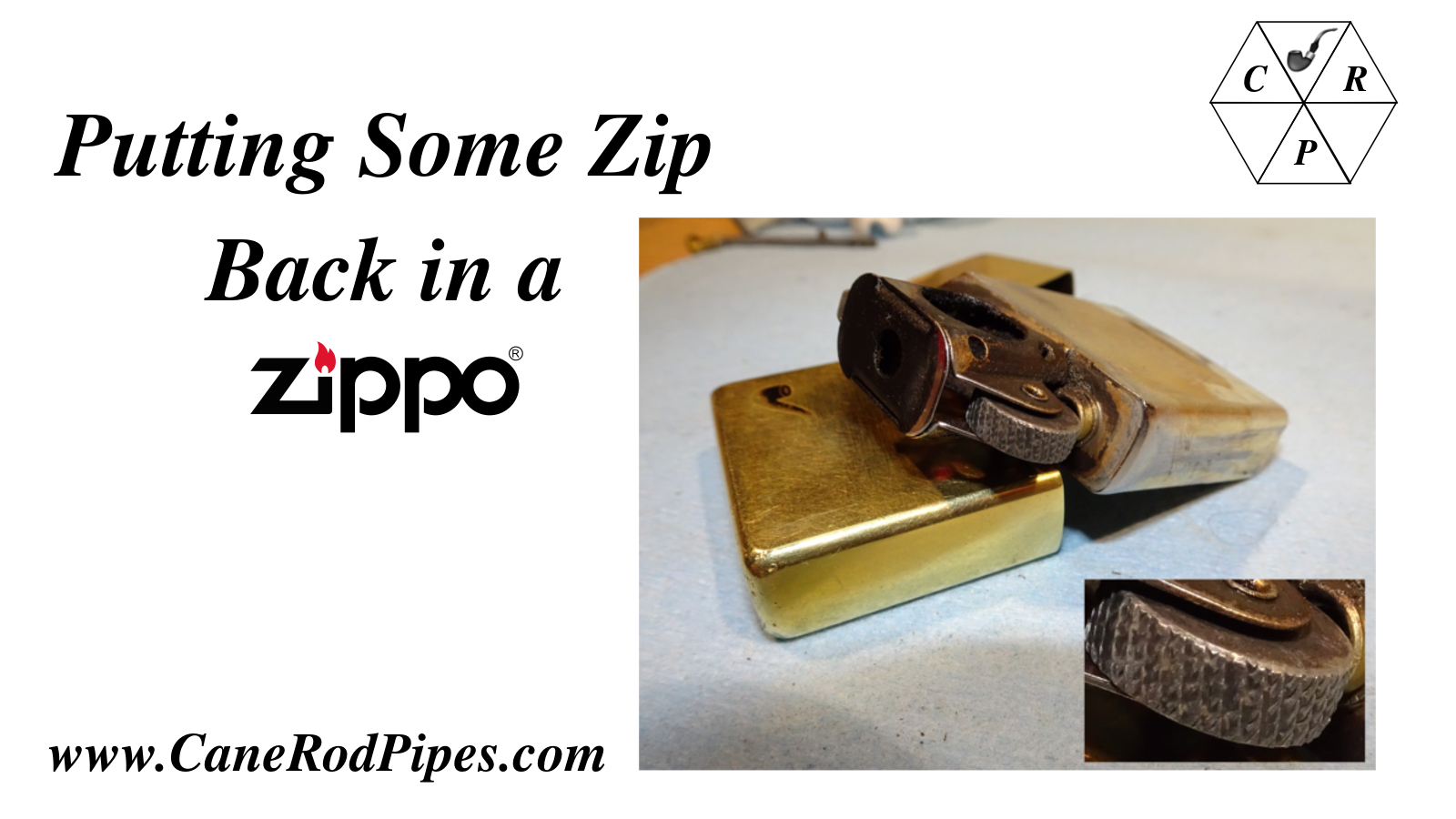
In the image below, you can see the striker wheel which I have enlarged as an inset on the lower right of the picture. It should be easy to see that the wheel has become glazed and is relatively smooth. The tips of the knurling still poke out enough so that there is some spark produced at the flint. But it takes multiple strikes to get the lighter to light.

The first step is to fully disassemble the lighter. The picture below shows the components. Clockwise from the top you can see the wick, rayon wadding, felt pad, flint screw with attached spring, a small piece of flint, the inner lighter assembly, and the case. The first step in disassembly is to remove the screw and flint spring. Everything else can then be pulled out from the bottom of the inner assembly.

Next, I place everything but the inner assembly to the side, and invert the inner assembly in a small jar of mineral spirits. The spirits should be just deep enough to ensure that the striker wheel is submerged. I then allow the wheel to soak for at least 1 hour. The choice of mineral spirits, also known as white spirits or mineral turpentine, is somewhat arbitrary on my part. I had it on hand, and it worked. Kerosene might also work. I don’t think that ethanol or methanol would be effective, but I have not tried them.

After soaking for at least an hour, the assembly is removed from the jar, and a brass brush is used to scrub the wheel. This can take some time, and it is necessary to use some care because the wheel freely turns and you need to make sure that you scrub all around the perimeter of the striker. You can see in the picture below that this process does a nice job of removing the glazing and restoring the rough knurling needed for effective striking. I could have continued to scrub the patina off the chimney and buff it with a bit of steel wool, but I don’t mind the used look at all.

Assembly is simply done by reversing the steps of disassembly. One word on setting the height of the wick. Most prefer the wick set as shown below. This will produce a reasonable flame that is perfectly adequate for lighting a pipe.

I discovered accidentally that setting the wick so that it just reaches the hole in the top of the chimney produces a much larger flame that I prefer. But be warned, it is a MUCH larger flame and you can easily burn yourself if you are not careful.

Once fully assembled, the lighter is back to lighting on the first strike. Now I can keep it with me and we can travel to Bradford together in the spring when I visit the Zippo Museum.

Very cool blog post. I am currently having the same problems with my Zippo that you described above. I’ll try to fix it here following your guidelines as I’m much like you in that I don’t want to part with my Zippo for any real length of time.
Thanks again, great blog!
Thank you David, I hope it works for you.
Great post again! Zippos are just such wonderful tools when one is out-and-about.
Thank you! I am glad that you enjoyed it!
Very interesting post I loved it very interesting and informative. I love my zippo and know how you feel.
Thank you George. They do become quite hard to part with.
Mike, that is very interesting, I love the Zippo design, what I never heard mentioned is about the great design of the flint dispenser, it is a work of art. When I was little I used to play with it! Also the design of the bottle of fluid is wonderful! I have the same problem with my Zippo, I’ll try something a bit easier, if it doesn’t work I’ll try your method. Thank You!
Peter
Hi Peter, Ah yes, the flint dispenser! I used to play with my father’s used flint dispensers. Wonderful bits of engineering. Good luck with getting your lighter back in shape.
I haven’t been without a Zippo in my pocket for 20 years. I’ve sent 4 in for repairs over that time and they’ve always lived up to their high customer service standard. I think I have around 15 Zippos right now and only one is sentimental to me (my grandpa’s, and I don’t use it so as not to wear away the image on the case any worse).
Your advice is much appreciated as always Mike, and I’ll be turning to it for sure when one of my striker wheels gets Glazey!
Glad you found it interesting Ben. And I understand the sentimental value of such an artifact. Hope you are well!
I had some problems with my Zippos not igniting on first strike. I simply took an old toothbrush to the wheel and removed the invisible flakes from flint striking and it now lights on first strike every time. No need to disassemble the Zippo at all. I definitely agree with filling the Zippo daily instead of completely filling it with fluid. Lighter fluid evaporates like crazy in all of my Zippo lighters and I have learned to fill for about 6 seconds daily to keep things going smoothly.
Thank you Randy. That is a good tip for regular cleaning and I will try it. But the state that this lighter was on required more than a toothbrush. I tried just the brass brush alone the first time I had the problem and it did nothing. But keep in mind, this lighter is striking 30-40 times a day for 10 or 12 years before it got to this state. Best, Mike.