
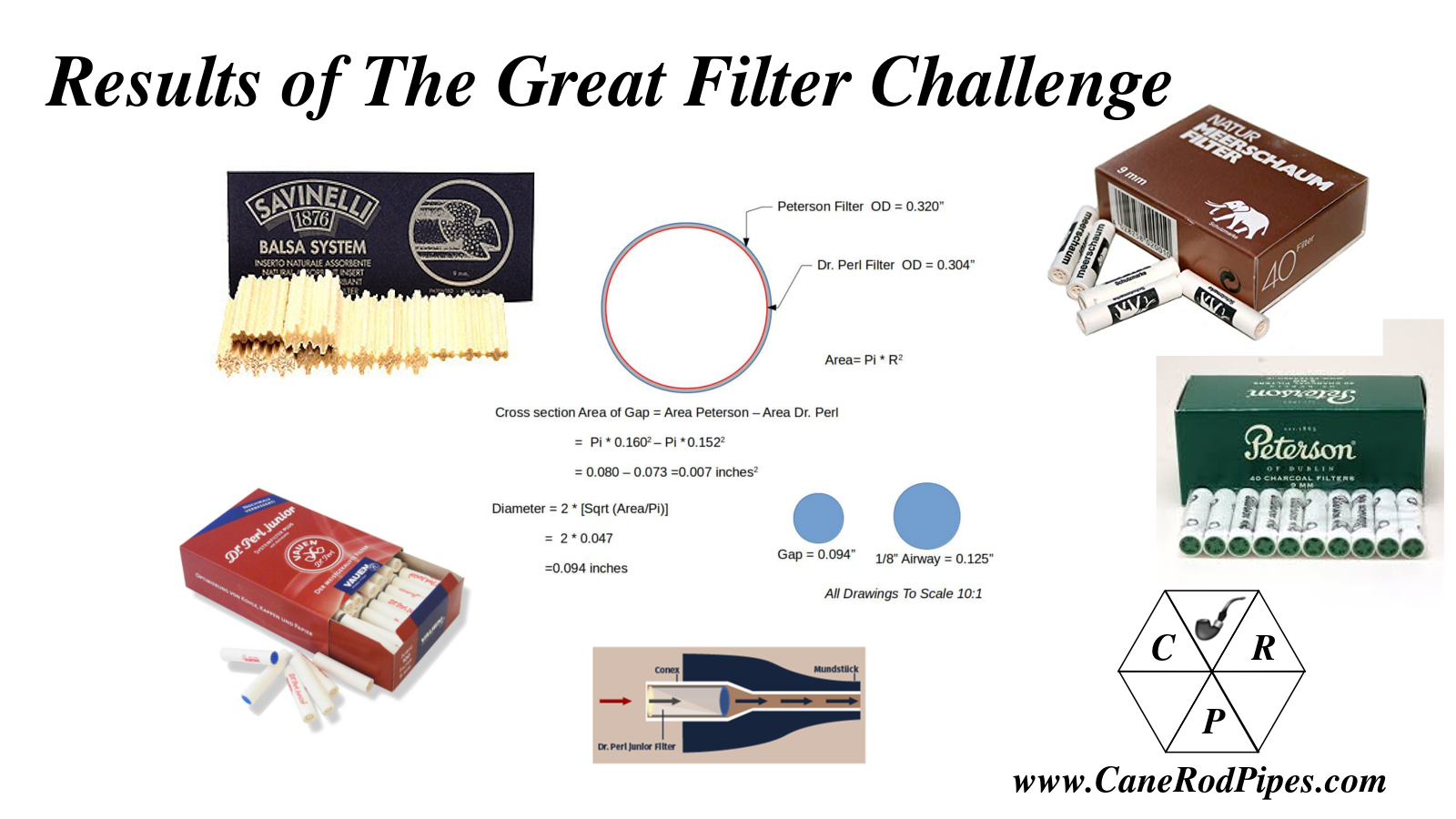
In my last post, I laid out the challenge of testing a set of 4 different filters in my new Savinelli 311 KS. I first smoked the pipe for several weeks using the Savinelli adapter that basically replaces the filter with an approximately normal airway. I smoked the pipe twice each week, and always smoked Peter Stokkebye Luxury Navy Flake (LNF). This is a blend that I have previously tried and found to be a nice Virginia flake that had a bit too much of a harsh edge to it. My hope was that some where along the way I would discover a filter that would make it a more enjoyable smoke. The adapter worked very well, and I found the pipe to have a nice open draw that made it easy to sip the LNF and enjoy the sweet grassy flavor that has a bit of a raisin/wine note that I grew to like more than I expected. But the harshness was a constant problem that detracted from my enjoyment of the smoke. For the record, the LNF was jarred in December of 2017, so it had a bit of age on it but was still on the “fresh” side. Perhaps a few years would do wonders, but I noticed no obvious difference in this jar compared to fresh samples I had previously smoked.
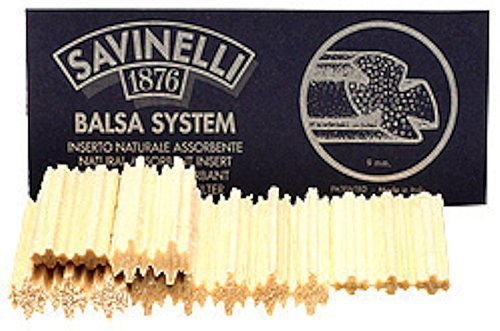
The first “filter” I tested was the Savinelli balsa insert. These inserts are technically not filters, although as I will explain I believe that they do perform some filtering of the smoke. The insert produced an obvious decrease in draw that I found annoying, but the pipe was still smokable. My first smoke with the insert was reasonable, and I would say that it had only a slight effect in diminishing the flavor of the smoke. Unfortunately it did produce what I am going to call a “green wood” flavor to appear in the smoke that was unpleasant. I’m guessing that as the balsa heats up, moisture or saps trapped in the wood sublimate and joing the smoke stream. I had hoped that a second smoke with the same insert might produce less of this flavor, however I never got the chance to try this because after allowing the pipe to cool for several hours I repacked it and found the draw to be decreased to the point where the pipe was not smokable. I’ve been told that I should remove the filter and wipe it off and let it dry out, but that is just too much effort for me. I smoke my pipes several times in a day and I don’t want to have to take them apart in between smokes. I also want to be able to run a pipe cleaner through the stem between smokes, but that was an issue with all of the filters tested.
As I mentioned previously, I don’t really have an issue with hot or wet smoke, so I can’t say much about those parameters, but I would guess that folks experience too much moisture might benefit from the balsa insert. It clearly collected moisture and swelled as it absorbed the moisture. It also was quite discolored with brownish goo. This is why I think the insert is doing some filtering. By disrupting the airway and creating turbulence, the insert causes water vapor to collect and fall out of the smoke stream. Since smoke is composed of water vapor, particulate matter, and a few soluble components like nicotine, some of the particulates and soluble compounds will come down with the water as it condenses. But it is important to note that this is not selectively removing certain things and letting others through. It is just removing a fraction of the smoke.
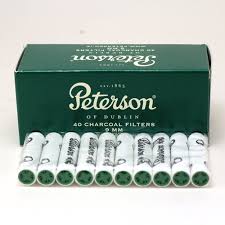
Next up was the Peterson activated charcoal filter. This was not a good experience. The filter dramatically reduced the draw, which is a non starter for me. I like an open draw. The Peterson filter also produced a significant decrease in flavor. So I was left with a thin tasteless smoke that made me think it was not worth finishing the bowl. Despite that, soldiered on and smoked 2 bowls with each of 2 filters (4 bowls total). The results remained uninspiring.
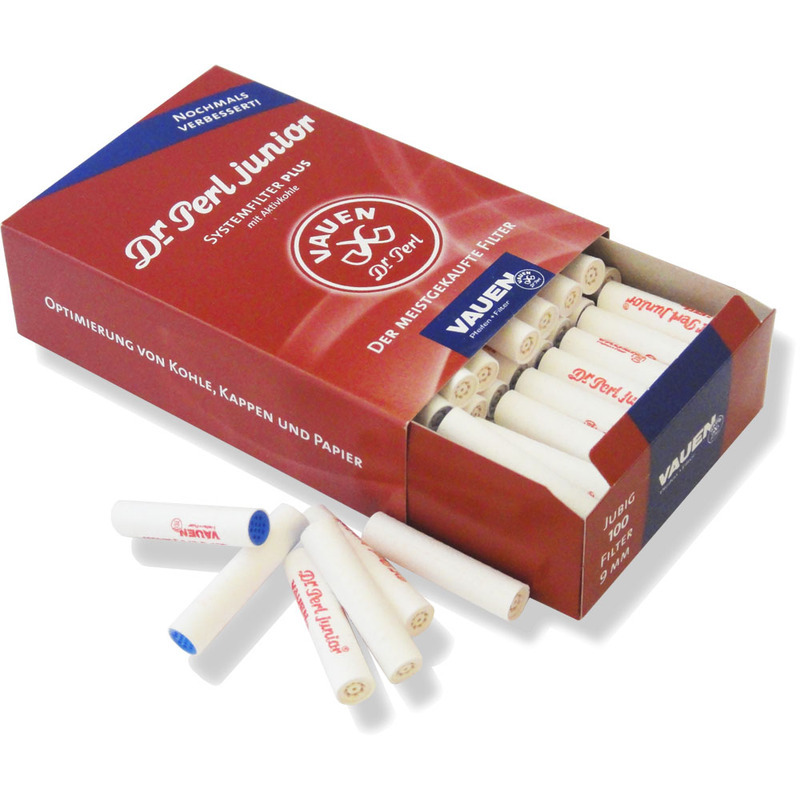
The Dr. Perl Junior filter was initially a pleasant surprise. It did not restrict the draw beyond what I had experienced with the balsa insert, and seemed to produce no effect on the flavor of the smoke. It also did not improve the flavor, as the LNF was still as harsh as ever, but it was the first filter I tried that was essentially equivalent to the filter-less pipe. I was fairly excited about this filter, but then a friend of mine (The Durham Duke) reminded me that it is important to make sure that the filter properly seals inside the stem. I measured the filters and the stems and found that the Dr. Perl Junior filters were 0.016 inches smaller in diameter compared to the Peterson filters. Now that might not seem like a great difference, however I did some calculations using basic high school geometry and found that the cross sectional area of the gap left by the Dr Perl filter was equivalent to a 3/32 inch diameter draft hole, just 1/32 inch less than a typical 1/8 inch airway.
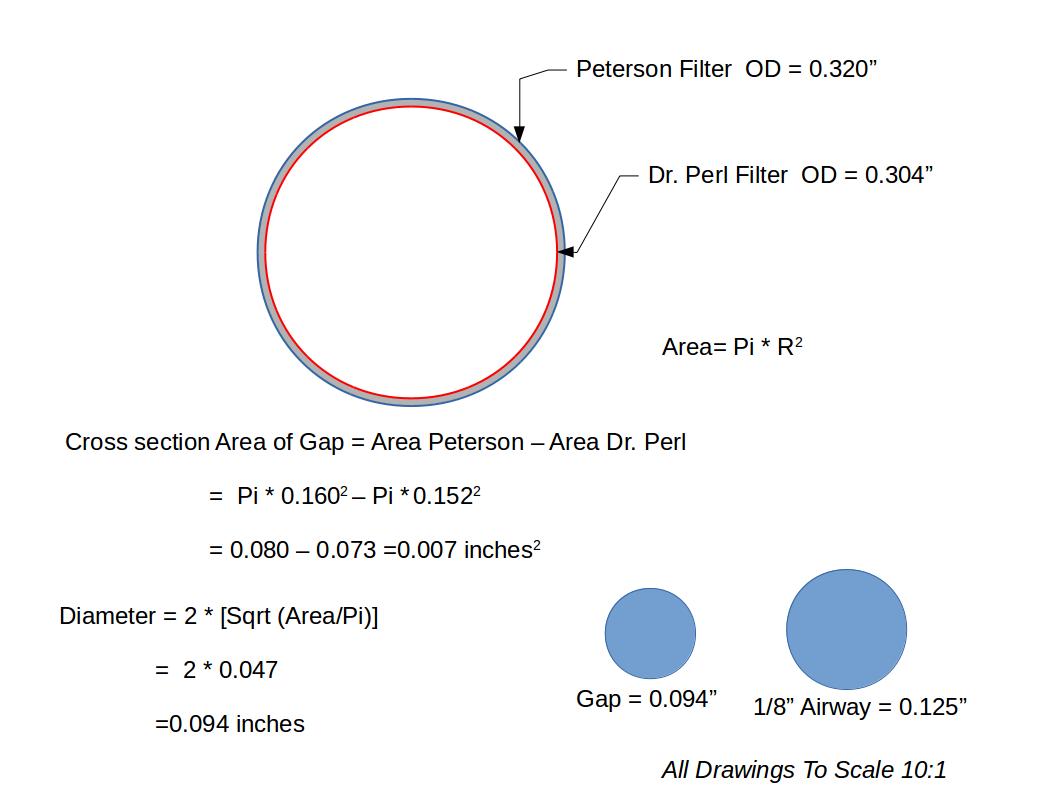
I next took a strip of typing paper that measured 0.004” thick and wrapped two layers around a Dr. Perl Junior filter this brought the diameter of the filter to the same as the Peterson filter. I used this paper wrapped filter in the pipe and essentially had the same smoking experience that I had with the Peterson filters. The draw was markedly diminished, and the smoke was thin and flavorless.
I was sufficiently surprised by this that I decided to do an experiment and record it in real time for a video on my YouTube channel. I used a small plastic disk which I glued over the plastic end of the filter. This effectively sealed off the filter and made it impossible to draw air through it. I then used this filter in the pipe and smoked a bowl of LNF for 15 minutes with no obvious problem. Some of the critics said that the filter swells to seal in the stem, yet this would have led to a blocked airway. Some also said that the filter would still have smoke pulled through it even though it did not seal. This would have defied physics, but it clearly could not happen with the filter sealed. And when the filter was removed, it was wet and discolored looking for all the world like it had been filtering the smoke. I believe that the Dr. Perl filters when used in a standard filter pipe, like this Savinelli, act similar to the balsa insert. They cause moisture to condense and are absorbent enough to collect the moisture. So while there may be some benefit, it is not a true filtering that is occurring with the poorly fit filter. I was feeling pretty good about myself now, thinking I had discovered something new, but I should have known better.
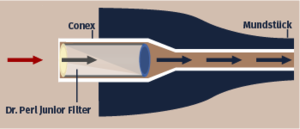
After going through all of that, it was brought to my attention by several YouTube friends that the Dr. Perl filters are designed to work in Vauen pipes with a Conex stem. In these stems there is a short section at the back of the filter chamber that tapers to a smaller diameter. The Dr. Perl Filters are meant to wedge into this section thus providing a sufficient seal. Everything makes sense now!
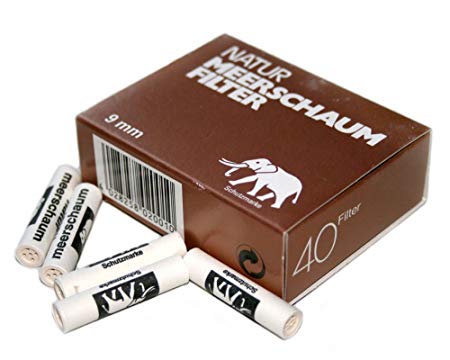
Interesting filter shoot-out. Your results mirror my (limited) experience with 6mm and 9mm filter pipes. Now the only “filter” I use is the Brigham system, which arguably isn’t a filter at all, but more of a moisture trap as you’ve already pointed out in your article. At this task it excels, IMHO, reducing tongue bite without restricting the airway.